

Agentic commerce: what UCP, ACP and AP2 are and why Adobe Commerce is backing them
AI agents no longer just recommend: they're starting to buy. Adobe Commerce has committed to supporting the UCP, ACP and AP2 standards. Here's what they are and what they mean for your store.
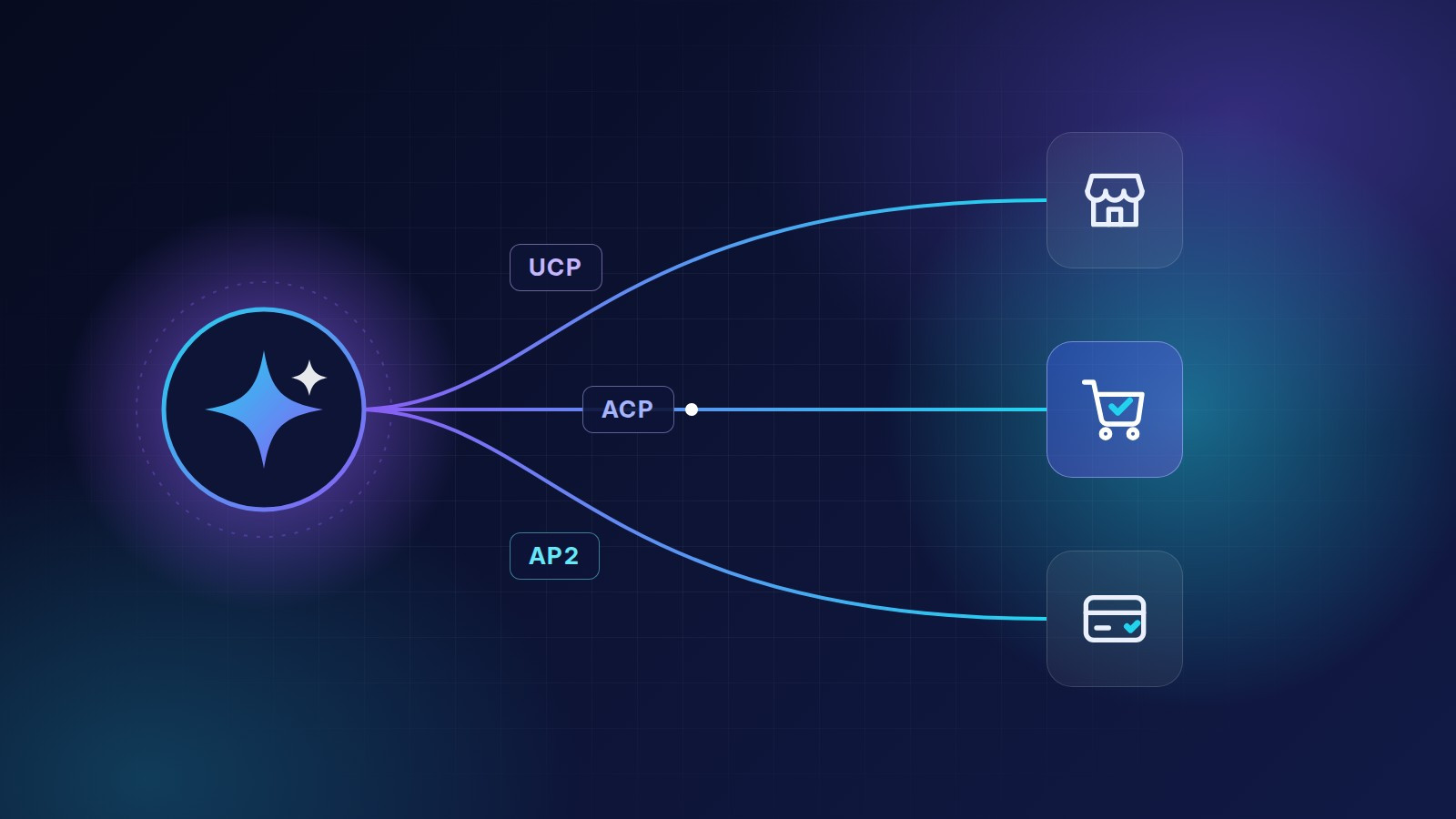
Picture this: a customer asks their AI assistant to "get me a waterproof hiking jacket, size M, delivered before Friday". The agent searches, compares, chooses and pays. The customer never visits your site.
That's agentic commerce, and it's already happening. That's why Adobe announced that Adobe Commerce will support the leading open agentic commerce standards: UCP, ACP and AP2. Let's look at what they are and why they should be on your radar.
The numbers behind the shift
According to Adobe data (Adobe Digital Insights, January 2026), during the 2025 holiday season:
- Retail site traffic driven by generative AI tools grew 693.4%.
- Visitors arriving from AI converted 31% better than other traffic.
- They generated 254% more revenue per visit.
- And spent 45% more time on site.
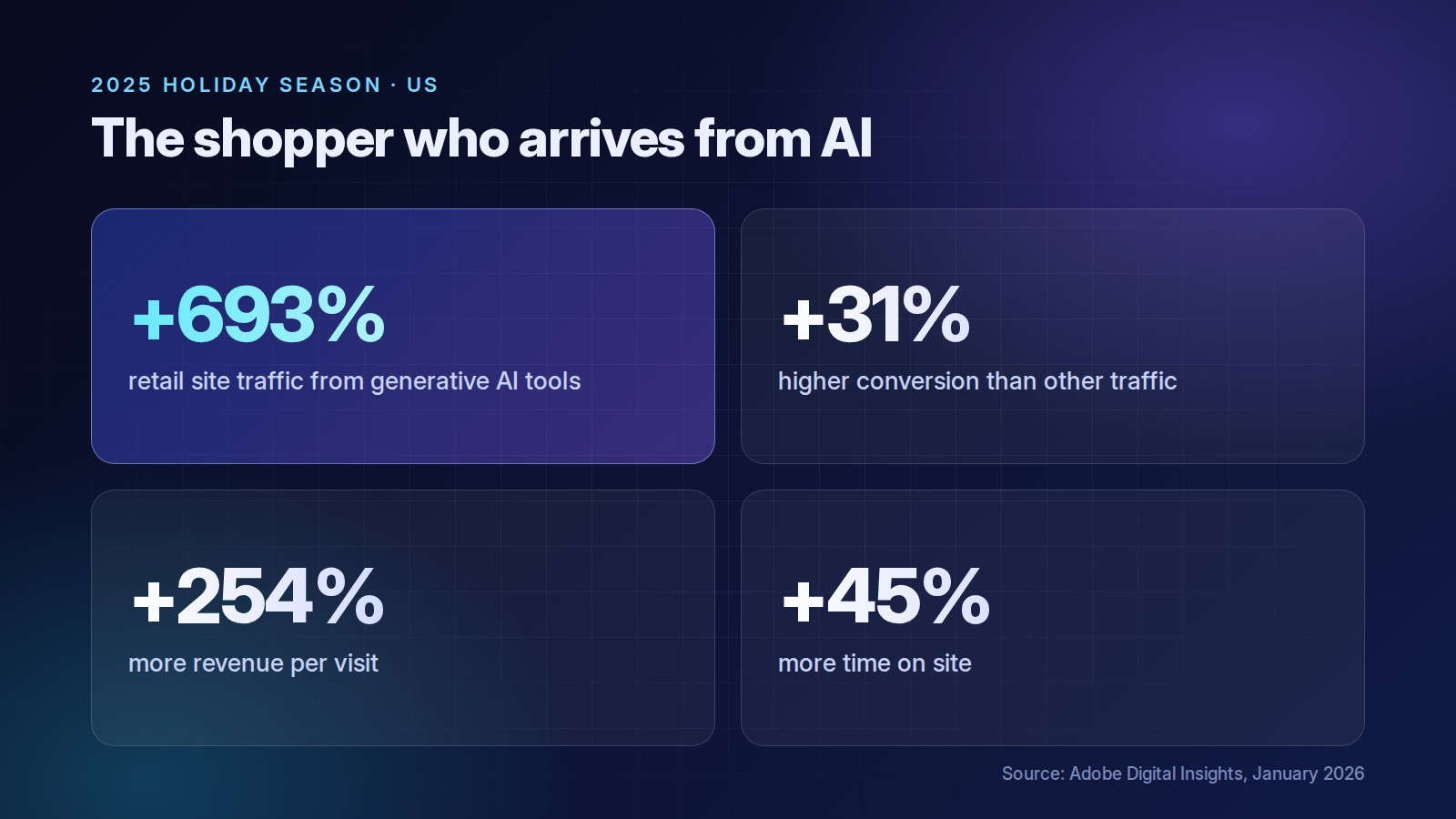
In other words: the shopper who arrives from AI is better informed and more ready to buy. And LLMs like ChatGPT and Gemini are becoming the new front door to ecommerce.
The three standards, simply put
For an AI agent to buy from your store, it needs to "speak the same language" as your platform. That's what these protocols are about:
| Protocol | Backed by | What it's for |
|---|---|---|
| UCP (Universal Commerce Protocol) | Standardizes how an agent discovers products, builds a cart and checks out with a merchant. | |
| ACP (Agentic Commerce Protocol) | OpenAI and Stripe | Lets users buy directly inside ChatGPT, connecting the agent to the merchant's checkout. |
| AP2 (Agent Payments Protocol) | Defines how an agent can pay on a user's behalf securely and verifiably. |
UCP and ACP target different consumer surfaces (Google's ecosystem on one side, ChatGPT on the other). Adobe's decision to support both matters: your store isn't locked into a single assistant.
What this enables in Adobe Commerce
According to Adobe, supporting these standards enables:
- Real-time product data available to agents in interfaces like ChatGPT and Gemini: catalog, pricing and inventory made machine-readable.
- Secure in-agent checkout, with standards-aligned payment flows.
- Order management integration, so an agent-initiated sale follows the same fulfillment path as any other.
- Brand control and accuracy over how products are presented.
The three-layer strategy
The most interesting part of Adobe's approach is that it isn't just about "selling through bots". It proposes thinking about ecommerce in three layers:
- Discovery. Getting AI to find you and describe you accurately. This is where Adobe Brand Visibility (formerly LLM Optimizer) comes in, structuring catalog and brand narrative for AI.
- Agent-to-agent commerce. Letting agents buy securely from your systems, via UCP and ACP.
- Brand-owned experiences. Making sure that when customers do reach your site, the experience is good enough to bring them back. Here you have Adobe Brand Concierge (an on-site conversational assistant), AEM Sites Optimizer and Adobe Commerce Optimizer.
As Loni Stark, VP of Strategy and Product at Adobe, puts it, brands face a dual imperative: optimize to be discovered by AI agents while deepening direct relationships with their customers.
What you should be doing today
- Get your catalog in order. No protocol helps if product data is incomplete or inconsistent.
- Review your payments and order stack. Agent-driven purchases need solid integrations with checkout, OMS and fulfillment.
- Don't neglect your storefront. Your own site is still where loyalty, first-party data and differentiation are built.
- Start measuring. Identify how much traffic and revenue already comes from AI.
In short
In Adobe's words: agentic shopping isn't a niche trend, it's the new front door for commerce. The good news for Adobe Commerce merchants is that the platform is getting ready for it, with more capabilities announced throughout 2026.
At Improntus we help you get your Adobe Commerce store ready for this new stage. If you want to get started, let's talk.
Source: Adobe Commerce commits to agentic commerce standards, Adobe Blog, February 2026.